Records of the Past, 2nd series, Vol. I, ed. by A. H. Sayce, [1888], at sacred-texts.com
(Texts: All Artifacts, Color Coding, & Writings in Bold Type With Italics Inside Parenthesis, are Added by Editor R. Brown, not the Authors, Translators, or Publishers!)
**(**gods in blue …mixed-breed demigods in teal…)
1. Assur-natsir-pal (II), the great king, the mighty king, king of the world, king of Assyria,
2. son of Tukulti-Uras, the great king, the mighty king, king of the world, king of Assyria, son of Rimmon-nirari,
3. the great king, the mighty king, king of the world, king of the same Assyria,
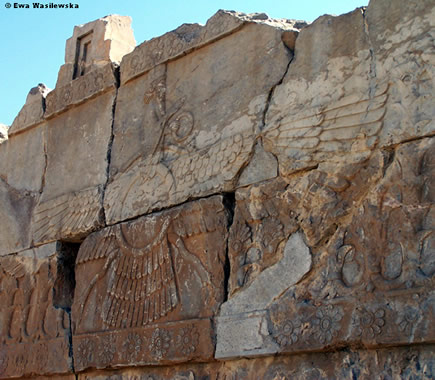 (Ashur protects his king from above)
4. the warrior chief, who with the help of Assur (Orien / Osiris) his lord
5. has marched, and among the princes of the four regions 1
6. his rival has not had; the king who from
7. beyond the Tigris to Lebanon and the great sea,
8. Laqi throughout its circuit,
9. ’Sukhi 2 as far as the city of Rapiqu to his feet
10. subdued; from the source 3
11. of the ’Supnat 4 to the passes of
12. Kirruri, to Gilzani, 5
13. from the other side of the lower Zab
14. to the city of Til-bari, which (is) above
15. Zaban, from the city of Til-sabtani
16. to the city of Til-sa-zabdani,
17. the city of Khirimu, the city of Kharutu, the fortresses
18. of Kar-Dunias 1 to the territory
19. of my country I restored, and the broad
20. lands of Nairi throughout its whole extent
21. I conquered. That city I took anew;
22. Imgur-Bel its name I called;
23. this temple with the brick of my palace
24. verily I built; an image of Makhir (unknown, Marduk ?)2 my lord
25. in the midst verily I set up; to Lebanon
26. verily I went; beams of cedar,
27. of cypress, of juniper I cut;
28. beams of cedar upon this temple
29. I fastened; doors of cedar
30. I made; with a rim of copper I overlaid (them);
31. at its gates I fixed (them); this temple
32. I furnished, I made great; Makhir the great lord
33. in the midst I seated; an inscribed tablet in his temple
34. I placed. O later prince of the kings

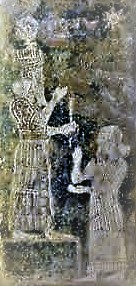 (Ashur; Ashur directs his Assyrian mixed-breed king)
35. my sons, whom Assur shall call,
36. (if) this temple decay, (and) the tablet thou see, and
37. read, its ruins do thou restore; thy name with my name write; 3
38. to its place do thou bring (it) back! Assur the lord, the great one, Makhir,
39. who dwells in this temple by their favorite 4 rightly
40. shall triumph; his tablet, his name, his seed in their land may they establish!
41. He who the tablet shall see, and offense in plenty
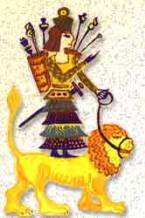
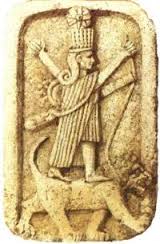 (Inanna, Goddess of War upon her zodiac symbol Leo)
42. speak, may Ishtar (Inanna)__, lady of fight and battle,
43. his weapons break in pieces, his throne
44. take from him! 1 He who the tablet shall see, and
45. read, (and) anointing the pavement-stones, sacrificing a lamb,
46. to its place shall restore (it), Assur the great lord his prayers
47. shall hear, (and) in the battle of kings, the field
48. of engagement, his heart’s desire 2
49. shall cause him to attain.
Footnotes
83:1 The translator in the Transactions of the Society of Biblical Archæology, p. 71, reads ina sar sa kiprat arbata, having evidently mistaken the wedges of the plural-sign for the character for “king.” 83:2 The Shuhites of the Old Testament (Job ii. 11), on the west bank of the Euphrates between the Balikh and the Khabour. 83:3 Ris ini, the source: not riseni, as one word, which would be, if anything, an anomalous plural from risu. 83:4 The Sebbeneh Su, which forms one of the sources of the Tigris north of Diarbekir. 83:5 [Or Guzan (Gozan).] 84:1 Babylonia. 84:2 In W. A. I., ii. 58, 12, Makhir is called “the daughter of Samas” (Utu); but the same deity is invoked as a male in one of the penitential psalms (W. A. I., iv. 66, 2) translated by Zimmern (Busspsalmen, p. 100), and Sayce (Hibbert Lectures, p. 355), “May Makhir_, god of dreams, rest upon my head!_” 84:3 There is no need here for an amendment of the text, which is plainly as follows: sumi-ka itti sumi-ya sudhur. 84:4 The phrase nisi ini, literally “the raising of the eyes,” means “grace” or “favor,” hence the object of such grace or favour, a favourite or darling (Liebling, Delitzsch). 85:1 By separating lu from the verb and giving it a temporal meaning the translator in T. S. B. A. (p. 78) has missed the force of this passage, which is clearly precative. See Delitzsch, Assyrian Grammar, p. 260. 85:2 Ammar libbi = mâla libbi, literally “the fullness of the heart;” cp. Esarhaddon, Hexagonal Prism, Col. iv. 41, amtsu mâla libbi, “I attained my heart’s desire.”