(Texts: All Artifacts, Color Coding, & Writings in Bold Type With Italics Inside Parenthesis, are Added by Editor R. Brown, not the Authors, Translators, or Publishers!)
(gods in blue … mixed-breed demigods in teal)
[…] … [… the slave girl] did not list[en to] her mistress. [They led their gods away, neglected their goddesses], abandoned [their rites], and embraced quite different (rites); […] they were inciting [criminal ac]ts (and) infringing on a taboo; […] they discontinued [sattuk]ku offerings. They fomented a conspiracy. They (Babylon’s citizens) put their hands on [the possessions of Esagil and the citizens of Babylon] and they plundered its goods, [gold, silver, (and) stones fr]om inside the temple (and) sold (them) at market value to the land Elam. 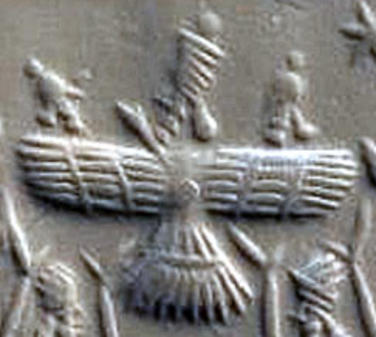 (Enlil, Anu, & Enki in their sky-disc) [The god] Enlil saw […] and his heart became angry (and) his mood became furious. [The Enlil of the gods, the lord of the lands], plotted evilly to scatter the land and people; [to level the land and to destroy] its [people], his heart was angry. A bitter curse was placed in his mouth.
Many [bad omens] concerning the destruction of mankind occurred [in heaven and on earth. The path of the Enlil-stars, the path of the Anu-stars, (and) the path of] the Ea-stars changed their position(s) for the worse (and) they constantly revealed signs portending destruction. […] … in the same way, its signs became increasingly bad. [The river Araḫtu, (normally) a river of abundance], turned into an angry wave, a raging tide, a huge flood like the deluge. It swept (its) [waters] destructively across the city, [its dwelling(s), (and) its shrines], and turned (them) into a swamp. 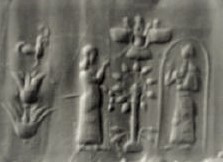 (Enlil, Anu, & Enki flying like birds above) The gods [(and goddesses) dwelling in it] flew up to the heavens like [bi]rds. The šēdus (and) [lamassus … fle]d and were wandering around outside. The people living [in it were hidden in another place] and took refuge in an unknown land.
 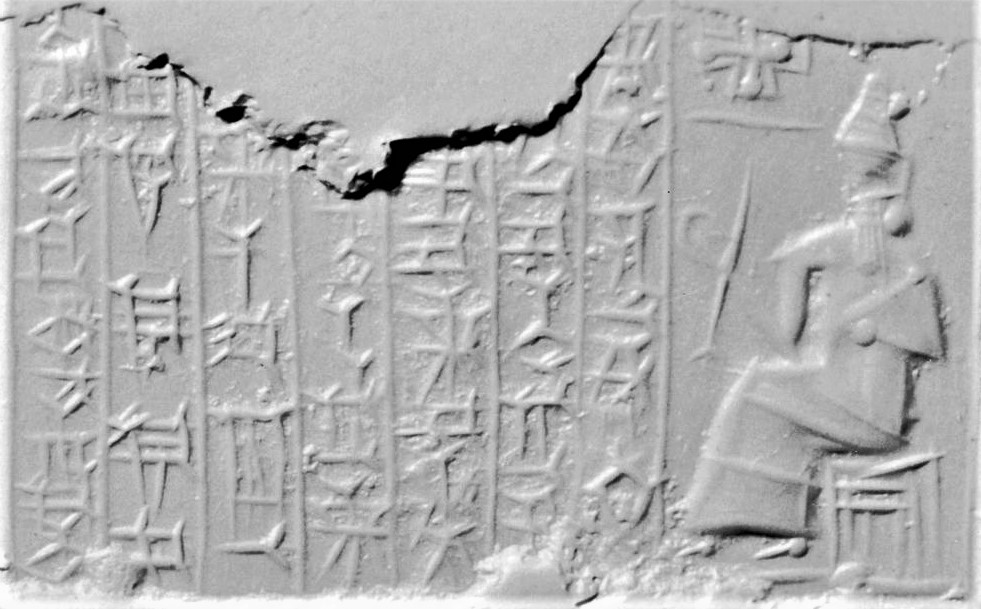 (Marduk) As time passed, [the heart of the great lord], the god Marduk, was soothed and he became reconciled with the land that he had punished. As the seventy years [passed, …] he (the god Marduk) wrote [‘11 years’], had pity, and said ‘Aḫulap!’
 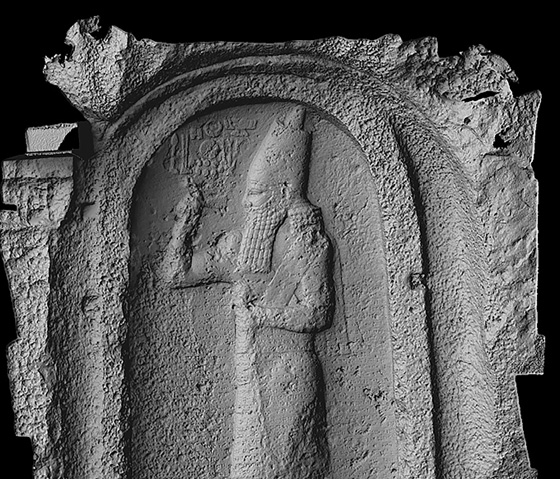 (wall relief of Esarhaddon) (As for) me, Es[arhaddon, …], who knows how to revere his great divinity, [… were established] for me at the beginning of [my kingship, in my first year, when] I sat [on the] throne of my priestly office, when I wore the crown of lordship, and […]. They (the gods) constantly revealed good omen(s) to me concerning the (re)population of the city and the temple. [Bright Jupiter(, the giver of decisions on Akkad,) came] near [in Simānu] and stood in the place where the sun shines. It was shining brightly (and) its appearance was [red. …] (and) there were copious [rains] (and) regular floods [in Akkad]. It (Jupiter) reached (its) [hyp]soma [for a second time in the month “Opening of the Door”] and [stayed] i[n its place]. [In order to triumph (and) to show overpowering strength], he (the god Marduk) reveal[ed to me] good omen(s) [concerning the (re-)entering of Esagil. Every month, the gods Sîn (Nannar) (and) Šamaš (Nannar’s son Utu) together, at their appearance, answered me with a firm] ‘yes’ [concerning (the renewing of the gods,) the completion of the shrines (and) cult centers, the stability] of my reign (and) the securing of the throne of my priestly office. [By means of the great intelligence] (and) vast understanding which [the sage of the gods, the prince, the god Nudimmud (Enki)], gave [to me, it occurred] to me [to (re)populate that city, to renovate] its [shrines], (and) to make the cult center shine, [and] my [mind prompted (me). [I was afraid (and) wo]rried [to perform that work] and [I knelt be]fore the gods Šamaš (Utu), Adad, (and) Marduk, the great judge(s), the god[s, my lords. In the diviner’s bowl], good [sig]n(s) were established for me, and they had (their response) concerning the (re)population of the city (and) the renovati[on of Esagil] written on a liver. [I trusted in their firm ‘yes’] and I mustered all of my craftsmen and (the people of) Karduniaš (Babylonia). I imposed baskets (on them and) had them wield ho[e]s. I mixed (the mud for) its revetment [with fine oil, honey, ghee, kurunnu-wine], muttinnu-wine, (and) mountain beer. I had its bricks made for a whole year [in brickmolds of musukkannu]-wood. I gathered together [expert craftsmen] (and) skilled master builders, who lay out plans. I laid the foundations of [Esagil, the palace of the gods], and secured its brickwork. [… fas]hioned skillfully (and) I drew its ground plan exactly as it had been written. [With] the large aslu-cubit, I measured the dimensions of […], in (exact) accordance with its earlier plan. […] I made its foundation platform as strong as the base of a mighty mountain, […] … (and) built its structure as it was in former days. I bui[lt Etemenanki, the ziqqurat], as it was before — its length [is one ašlu (and) one ṣup]pān, (and) its width is one ašlu (and) one ṣuppān. I offered pure offerings to […] the great [gods] and the god Kulla (Apkulla), the lord of foundations (and) bricks. I laid their foundations with […] …, wine, (and) kurunnu-wine, and I secured [their] footings. [I had foundation inscriptions made of (…)] basalt [(and) I wro]te [on them] the glory of the great lord, my lord, and I pl[ace]d (them) in their (Esagil’s and Etemenanki’s) midst. […] I restored its precious [ritu]als and [… I] established […] … […] … […]